


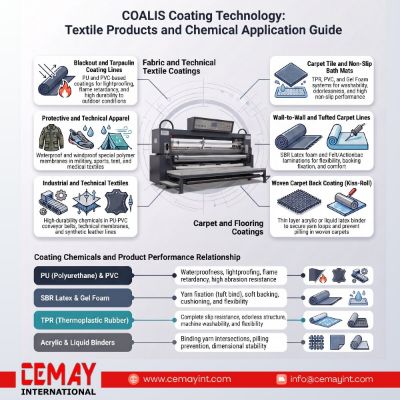
Whether a COALIS coating line turns out a waterproof tarpaulin, a non-slip bath mat or a woven carpet that does not shed is decided largely by the coating chemical. The chemicals used in fabric and carpet coating fall into four families: PU and PVC, SBR latex and gel foam, TPR, and acrylic/liquid binders. Each one gives the product a different kind of performance.
Which chemical gives the product which performance?
| Chemical family | Performance it adds | Typical products |
|---|---|---|
| PU (polyurethane) and PVC | Waterproofing, lightproofing, flame retardancy, high abrasion resistance | Blackout fabric, tarpaulin, conveyor belts, synthetic leather |
| SBR latex and gel foam | Yarn fixation (tuft bind), soft backing, cushioning and flexibility | Wall-to-wall and tufted carpet, non-slip mats |
| TPR (thermoplastic rubber) | Complete slip resistance, odourless structure, machine washability and flexibility | Bath mats, washable rugs and mats |
| Acrylic and liquid binders | Binding yarn intersections, preventing pilling, dimensional stability | Woven carpet back coating |
Which chemicals are used on fabrics and technical textiles?
On the fabric side, the performance expected is usually a barrier: against light, water, wind, flame or abrasion. That is why PU, PVC and special polymer membranes dominate.
- Blackout and tarpaulin coating lines — PU and PVC-based coatings give lightproofing, flame retardancy and high durability in outdoor conditions.
- Protective and technical apparel — military, sports, tent and medical textiles use waterproof and windproof special polymer membranes.
- Industrial textiles — PU-PVC conveyor belts, technical membranes and synthetic leather lines rely on high-durability chemicals.
Which chemicals are used in carpet and floor coverings?
In carpet, the first job of the coating is to hold the yarn in place; comfort, slip resistance and washability come next. So the choice of chemical follows the construction of the carpet.
- Carpet tiles and non-slip bath mats — TPR, PVC and gel foam systems, for washability, odourlessness and high slip resistance.
- Wall-to-wall and tufted carpet — SBR latex foam with felt or ActionBac secondary backing lamination, for flexibility, backing fixation and comfort.
- Woven carpet back coating (kiss-roll) — a thin layer of acrylic or liquid latex binder, to secure yarn loops and prevent pilling.
Which unit of the line does the chemical decide?
The form of the chemical (paste, foam, thin liquid) also decides which application unit the line needs. With the right units, the same COALIS line can work with more than one chemical family.
| Chemical | How it is applied | Related system |
|---|---|---|
| PU / PVC | Spread on the fabric with a doctor blade, then dried and fixed | COALIS Fabric Coating Machine |
| SBR latex foam | Foam application and secondary backing (felt, ActionBac) lamination | Latex Foam Application Systems, Secondary Backing Systems |
| Gel foam | Embossed non-slip backing surface | Gel Foam Anti-Slip Backing Solutions |
| PVC / TPR | Back coating for carpet tiles and mats | Carpet Tile & Mat Back Coating Systems |
| Acrylic / liquid latex | Thin layer on woven carpet backs by kiss-roll | Carpet Kiss Roll Coating Machine |
You can find the fabric applications on our Blackout Coating Line, Tarpaulin Coating Line, Conveyor Belt Coating and Synthetic Leather and Coagulation Coating pages. We compared latex, TPR and PVC for carpet backing in carpet backing solutions, and covered choosing by product type in how to choose a carpet backing solution. If you would like to discuss which chemical and line configuration suit your product, you can reach us through our quote form.
Frequently Asked Questions
Should carpet backing use SBR latex or TPR?
It depends on the product. SBR latex fixes the yarns (tuft bind) and gives a soft, flexible backing, which suits wall-to-wall and tufted carpet. TPR gives complete slip resistance, an odourless structure and machine washability, which is why it is preferred for bath mats and washable rugs.
What does kiss-roll coating do?
It applies a thin layer of acrylic or liquid latex binder to the back of a woven carpet. The layer binds yarn intersections, secures the loops, prevents pilling and gives the carpet dimensional stability.
Which coating chemical is used on blackout and tarpaulin fabrics?
PU and PVC-based coatings. They give the fabric lightproofing and waterproofing, flame retardancy and high abrasion resistance in outdoor conditions.