Secondary Backing Systems

SKU: CEMAY-HALI-HAT-IKINCIL-TABAN
Request a Quote
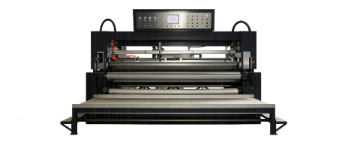
Line that coats the back of tufted carpet with a latex precoat and laminates a secondary backing (Action Back or felt) onto it while the coat is still wet, with stenter (RAM) drying.

A secondary backing system adds a second backing fabric to the back of tufted carpet. First a precoat of latex filled with calcium carbonate is applied to the carpet back; it locks the pile loops into the primary backing. The secondary backing is laid onto the carpet back while the coat is still wet and tacky, and joined to it between pressing rollers. An Action Back (woven polypropylene) secondary backing gives the carpet strength and resistance to stretching; a felt secondary backing gives it padding and insulation. The result is a carpet with high dimensional stability that lies flat and does not delaminate.

Carpet and secondary backing path
Secondary backing line — the carpet and secondary backing path over an example layout drawing Side view of an example tufted carpet coating and laminating line. The carpet travels left to right: after the edge-control lifter, entry and centring and the J-box it takes its precoat at the applicator (COALIS coating machine). The secondary backing, unwound at the lamination feed unit, meets the carpet back at the stenter entry while the coat is still wet and is pressed on at the embossing unit; the carpet dries in the stenter, is cooled, edge-trimmed and reaches the accumulator. The paths are shown as red lines. 1 2 3 4 5 6 7 8 9 10 11 12

↔ Scroll sideways to see the whole line

  1. 1Edge-Control Pneumatic Lifter
  2. 2Carpet Entry and Centring
  3. 3J-Box
  4. 4Applicator (COALIS Coating Machine)
  5. 5Lamination Feed Unit
  6. 6Stenter Chain Entry Rails
  7. 7Embossing Unit
  8. 8Stenter (RAM)
  9. 9Cooling Unit
  10. 10Stenter Exit Frame
  11. 11Edge Cutting Machine
  12. 12Accumulator
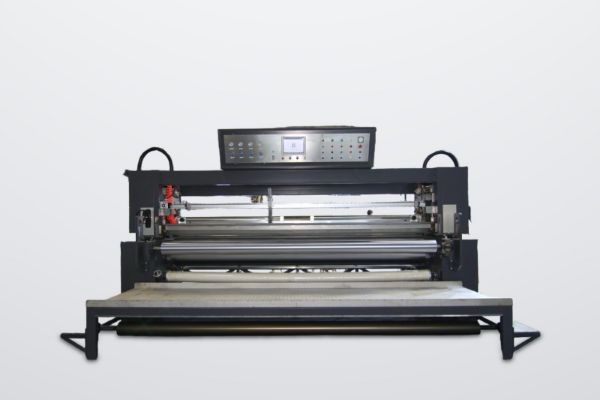
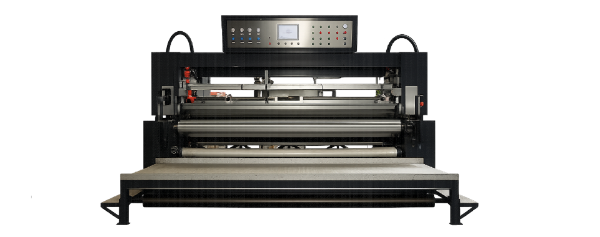
Example tufted carpet coating and laminating line layout, side view: with an applicator, a lamination feed, an embossing unit and stenter (RAM) drying. The line runs left to right; the red lines are the paths the carpet and the secondary backing follow. The units are designed for the secondary backing line to the customer's and the process's requirements.

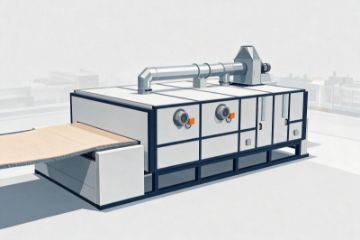
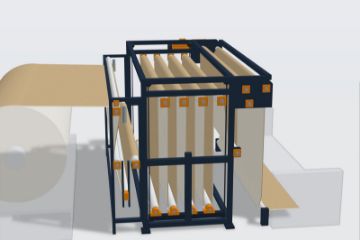
In the example line the carpet takes its precoat after the J-box (3) at the applicator (4), the COALIS coating machine. The lamination feed unit (5) unwinds the secondary backing onto the carpet; the two layers pass the stenter chain entry rails (6), are pressed together between the nip rollers of the embossing unit (7) and dry in the stenter (8). Tufted carpet needs the stenter: it holds the carpet by its edges with pins or clips and keeps its width, preventing shrinkage and distortion as it dries. The carpet is cooled (9), edge-trimmed (11) and reaches the accumulator (12).

The line in the drawing is an example with a working width of 4200 mm and a four-chamber gas-fired stenter. The coating method, the type of secondary backing and the drying length are set for your carpet and capacity at the quotation stage; installation, commissioning and process training are carried out by CEMAY engineering.

Products specifications
Attribute name Attribute value
Mechanical
Working Width 4200 mm (in the example drawing)
Knife Type Knife-over-roll or knife-over-air (precoat)
Calender Pressure Pneumatically adjustable lamination pressure (embossing unit)
Accumulator Length 30 m (in the example drawing)
Process
Chamber Count / Length 4-chamber stenter (in the example drawing)
Heating Type Gas-fired (in the example drawing)
*
*
*