


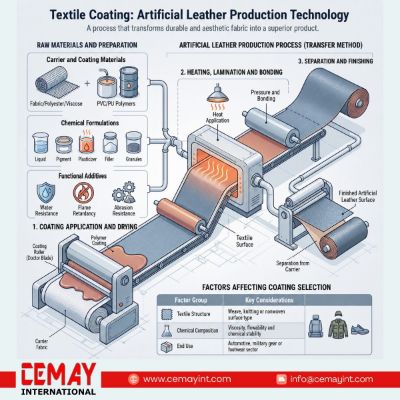
Artificial leather is a coated surface produced by spreading a polymer coating onto a carrier, bonding it to a textile surface with heat and pressure, and then separating the carrier. That route is called the transfer method: a process that turns raw textile into a durable and aesthetic product in three stages.
Which three stages make up the transfer method?
- Coating application and drying — the polymer coating is spread onto the carrier fabric by a coating roller with a doctor blade.
- Heating, lamination and bonding — the textile surface is joined to that layer under heat application and pressure.
- Separation and finishing — the carrier is stripped away, leaving the finished artificial leather surface.
Why is the coating applied to a carrier rather than straight onto the fabric?
Because the face that stays on the outside is the one formed against the carrier. The polymer becomes a layer on the carrier surface first; the textile is then bonded to that layer from behind. When the carrier is separated in the last stage, the surface that appears is the layer's carrier-facing side.
Which raw materials go into artificial leather?
The base textile can be fabric, polyester or viscose. The coating applied on it is PVC or PU (polyurethane) polymers. Those polymers do not go on neat: the formulation carries liquid, pigment, plasticizer, filler and granules.
Which functional additives does the coating carry?
- Water resistance — the surface repels water.
- Flame retardancy — burning behaviour is held back.
- Abrasion resistance — resistance to rubbing goes up.
The three are not asked for all at once: which one comes to the front follows the sector the product is going to.
What settles which coating to use?
| Factor group | Key considerations |
|---|---|
| Textile structure | Weave, knitting or nonwoven surface type |
| Chemical composition | Viscosity, flowability and chemical stability |
| End use | Automotive, military gear or footwear sector |
The three rows are not independent: producing automotive upholstery on a nonwoven base and footwear on a woven base will not want the same chemical at the same viscosity.
You can look through our line for the transfer and the coagulation route on the Synthetic Leather and Coagulation Coating page, and the Lacquering Line for surface finishing. For the fundamentals, what is textile coating is the starting point. To work out how the line should be configured for your own product, reach us through the quote request form.
Frequently Asked Questions
What is the transfer method in artificial leather production?
It is spreading the polymer coating onto a carrier fabric with a doctor blade, bonding the textile surface to that layer with heat and pressure, and separating the carrier in the final stage. What remains is the finished artificial leather surface.
Which polymers are used to coat artificial leather?
PVC and PU (polyurethane) polymers, applied on a base of fabric, polyester or viscose. The formulation carries liquid, pigment, plasticizer, filler and granules.
How is the coating for artificial leather selected?
By three factor groups: the textile structure (weave, knitting or nonwoven), the chemical composition (viscosity, flowability and chemical stability) and the end use (automotive, military gear or the footwear sector).