


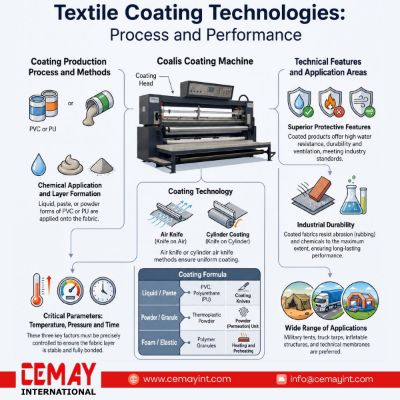
A coating chemical is not applied to the fabric in one single way but in three separate forms: liquid/paste, powder/granule and melt. Which form you work in decides not only the chemical but which unit the line has to carry.
In which forms is the coating applied?
| Coating form | Material used | Unit the line needs |
|---|---|---|
| Liquid / paste | PVC, polyurethane (PU) | Coating knives |
| Powder / granule | Thermoplastic powder | Powder unit |
| Melt | Polymer granules | Heating unit |
Why does the form decide the line as well?
Because the three forms ask for three different transfer mechanics. Liquid and paste are metered off by a blade, so the line needs coating knives. Thermoplastic powder cannot be metered that way — it has to be distributed over the fabric, and a powder unit does that. Polymer granules have to be melted before they can be applied at all, which makes a heating unit mandatory. The form is a line decision before it is a chemical one.
How is the coating transferred onto the fabric?
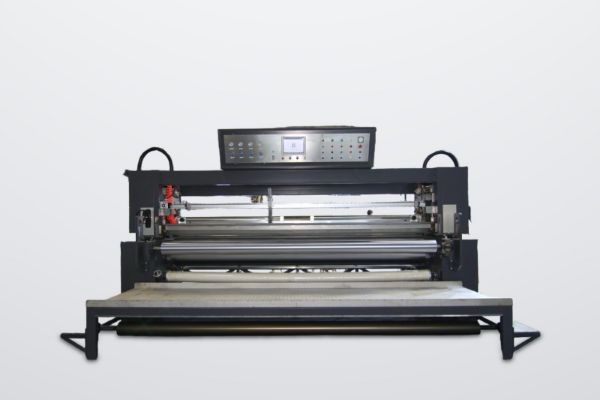
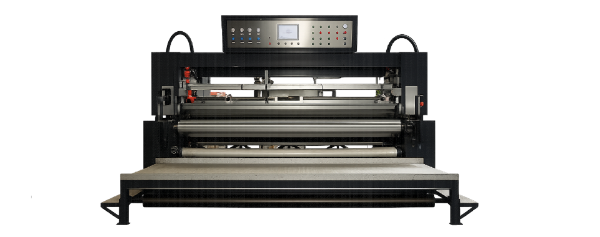
Liquid, paste or powder forms of PVC or PU are applied onto the carrier fabric, and what performs the transfer is the blade in the coating head. Two methods are used: air knife (knife on air) and cylinder coating (knife on cylinder). Both have the same aim — distributing the coating uniformly across the width.
What is the difference between knife-on-air and knife-on-cylinder?
The support underneath the blade. With knife-on-air the fabric passes under the blade over an unsupported span, held only by its own tension. With knife-on-cylinder the fabric runs against a rotating roll and the blade works over that hard backing. How the transferred chemical weight is pinned down is covered under add-on control in our latex, TPR and PVC note.
Why are temperature, pressure and time controlled together?
Whether the applied layer becomes stable and fully bonded to the fabric depends on all three, and all three must be precisely controlled. Hit one and let another drift and the layer merely sits on the fabric — what is wanted is for it to bond with it.
What performance does a coated fabric gain?
- Superior protective features — coated products reach high water resistance, flame retardancy and air impermeability standards.
- Industrial durability — coated fabrics resist abrasion (rubbing) and chemicals to the maximum extent, which is what makes the performance long-lasting.
Where are these fabrics used?
Military tents, truck tarps, inflatable structures and technical membranes — none of the four stands up without the water resistance and durability the coating brings.
We walked through the line stage by stage in tarpaulin coating production technology, and the differences between polymer types in tarpaulin coating technologies. Our line is on the Tarpaulin Coating Line page, and the blade coating unit on the fabric coating machine page. To work out which form fits your product, reach us through the quote request form.
Frequently Asked Questions
Which coating forms are used in textile coating?
Three forms: liquid/paste (PVC and polyurethane, applied with coating knives), powder/granule (thermoplastic powder, applied with a powder unit) and melt (polymer granules, applied through a heating unit).
What is the difference between knife-on-air and knife-on-cylinder?
The support underneath the blade. With knife-on-air the fabric passes over an unsupported span held by its own tension; with knife-on-cylinder it runs against a rotating roll. Both are used to distribute the coating uniformly across the width.
Where are coated tarpaulin fabrics used?
In military tents, truck tarps, inflatable structures and technical membranes. The coating gives those products high water resistance, flame retardancy and air impermeability, plus abrasion and chemical resistance.