


Coating an umbrella or sunshade fabric means transferring a protective chemical evenly onto a high-performance filament fabric, then crosslinking the polymers in a dryer unit so the fabric gains durable water repellency. The process has two halves: raw materials and components first, then coating and fixation.
Which fibre is selected, and why?
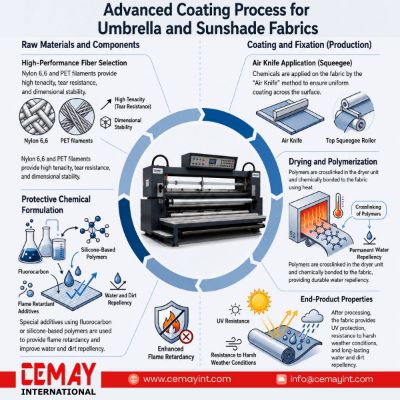
Nylon 6,6 and PET filaments. Both provide the same three things: high tenacity, tear resistance and dimensional stability. Those come from the fabric, not from the coating — a coating does not make up for a weak base. That is why fibre selection sits in the preparation step.
How is the protective chemical formulated?
Two functions come from two different components. Fluorocarbon or silicone-based polymers improve water and dirt repellency; special flame retardant additives provide flame retardancy. The formulation is those two groups working together, and its output is both water and dirt repellency and enhanced flame retardancy.
How is the chemical transferred onto the fabric?
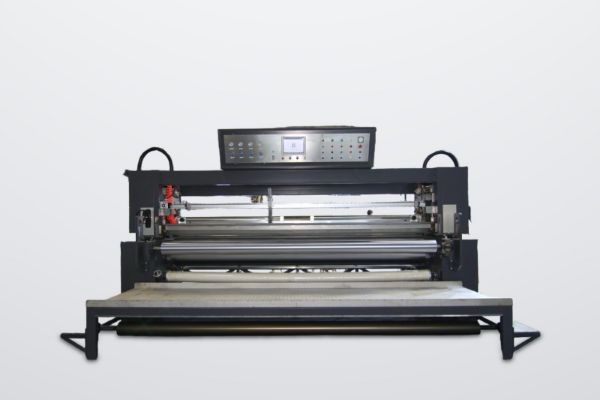
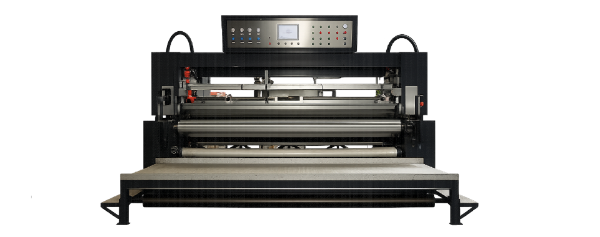
By air knife application, with a top squeegee roller. Chemicals are applied on the fabric by the "Air Knife" method to ensure uniform coating across the surface. "Uniform" is the operative word: a coating that is the same across the width means the water repellency obtained in the next step is the same across the width too.
How is durable water repellency achieved?
By crosslinking. Polymers are crosslinked in the dryer unit and chemically bonded to the fabric using heat, which is what makes the water repellency durable. Without that crosslink the chemical is not chemically bonded to the fabric at all — it merely sits on the surface.
What properties does the finished fabric have?
| Property | Where it comes from |
|---|---|
| High tenacity, tear resistance and dimensional stability | Nylon 6,6 / PET filament selection |
| Water and dirt repellency | Fluorocarbon or silicone-based polymers |
| Enhanced flame retardancy | Flame retardant additives |
| Durable water repellency | Crosslinking in the dryer unit |
After processing, the fabric provides UV protection, resistance to harsh weather conditions, and long-lasting water and dirt repellency.
You can look through our line for umbrella and sunshade fabric on the Outdoor Technical Textile Coating page. The unit where crosslinking happens is on the Drying System (RAM / Stenter) page. To work out the formulation and the line for your own fabric, reach us through the quote request form.
Frequently Asked Questions
Which fibres are used in umbrella fabrics?
Nylon 6,6 and PET filaments. Both provide high tenacity, tear resistance and dimensional stability — properties that come from the fabric itself rather than from the coating.
How do umbrella fabrics get water and dirt repellency?
From fluorocarbon or silicone-based polymers in the protective formulation. Flame retardancy comes from special flame retardant additives added to the same formulation.
How does the coating become durably water-repellent?
Through crosslinking in the dryer unit: the polymers are crosslinked and chemically bonded to the fabric using heat. Without that step the chemical only sits on the surface.