


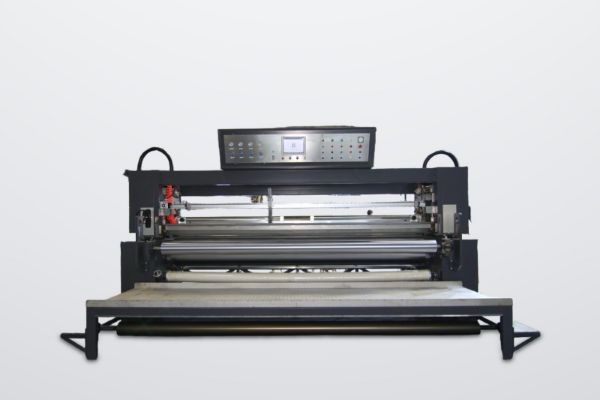
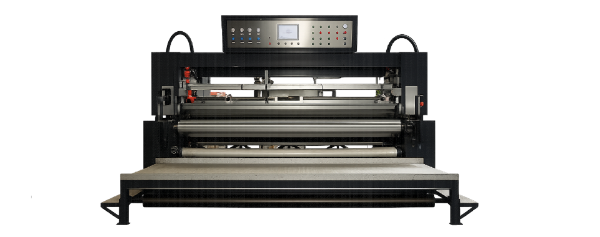
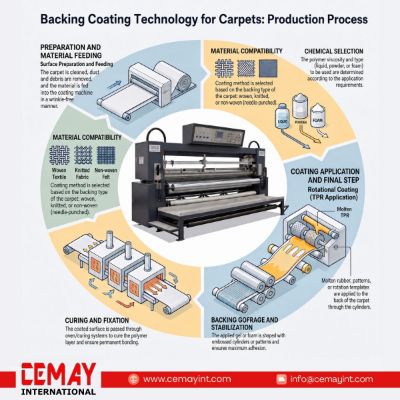
Non-slip carpet backing is the transfer of molten rubber onto the back of the carpet through patterned cylinders, shaped by embossing and cured in oven systems so the polymer layer becomes permanent. The line runs in two phases: preparation and material feeding first, then coating application and the final step.
What is the running order of the line?
| Phase | Step | What happens |
|---|---|---|
| Preparation and material feeding | Surface preparation and feeding | The carpet is cleaned and fed in wrinkle-free |
| Material compatibility | The method is selected by woven, knitted or non-woven backing | |
| Chemical selection | Polymer viscosity and type (liquid, powder, foam) are determined | |
| Coating application and final step | Rotational coating (TPR) | Molten rubber is applied through patterned cylinders |
| Backing gofrage and stabilization | The gel or foam is shaped with embossed cylinders | |
| Curing and fixation | Oven/curing systems make the polymer layer permanent |
Why does preparation come before coating?
The carpet is cleaned, dust and debris are removed, and the material is fed into the coating machine in a wrinkle-free manner — all of which is critical to coating quality. A coating transferred onto a wrinkled surface runs thin where the wrinkle opens out; the fault then originates not in the coating unit but in the feeding before it.
How does the carpet's structure change the coating method?
The coating method is selected based on the backing type of the carpet: woven, knitted or non-woven (needle-punched). Three structures mean three different surfaces, and the same chemical will not adhere to all three the same way. We covered what those structural differences mean in carpet production in the three pillars of carpet production.
What does chemical selection determine?
The precision of the application. The polymer viscosity and type to be used — liquid, powder or foam — are determined according to the application requirements. So the chemical decision is as much a decision about how finely the line can be tuned as it is a materials decision.
How does rotational TPR application work?
Molten rubber, patterns or rotation templates are applied to the back of the carpet through the cylinders. The pattern on the transferring cylinder decides where and how much rubber lands on the backing — the precision of the step is the cylinder's work.
How is the non-slip grip created?
By gofrage. The applied gel or foam is shaped with embossed cylinders or patterns, which ensures maximum adhesion. The grip is not added as a separate layer; it is obtained by texturing the surface of the layer already applied.
How is the polymer layer made permanent?
The coated surface is passed through oven/curing systems to cure the polymer layer and ensure permanent bonding. Even if the first five steps are right, an incomplete cure leaves the coating impermanent.
Which backing solution fits your product type is set out in how to choose a carpet backing solution, and the latex/TPR/PVC differences in latex, TPR and PVC. Our lines are on the Carpet Backing Coating application page and the gel/foam application on the Gel Foam (Embossed Anti-Slip) Backing Solutions page. To discuss how the line should be set up for your own carpet, reach us through the quote request form.
Frequently Asked Questions
What steps make up the non-slip carpet backing process?
Six: surface preparation and feeding, determining material compatibility, chemical selection, rotational TPR application, backing gofrage and stabilization, and finally curing and fixation in oven systems.
How does the carpet's structure affect the coating method?
The coating method is selected based on the backing type of the carpet — woven, knitted or non-woven (needle-punched). Three structures mean three different surfaces, and the same chemical will not adhere to all three the same way.
How is non-slip grip achieved on a carpet backing?
By shaping the applied gel or foam with embossed cylinders or patterns. The grip is not added as a separate layer; texturing the surface of the applied layer is what ensures maximum adhesion.